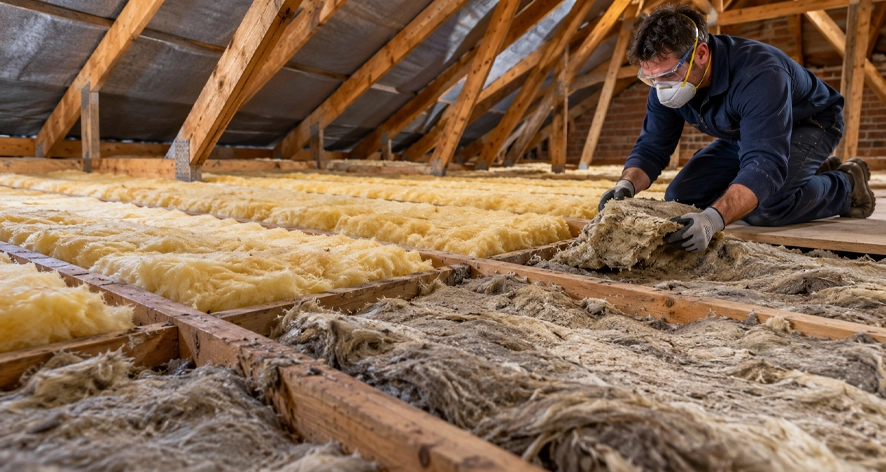
Insulation rarely fails all at once. It flattens, shifts, gets damp and gets pushed aside, and the house slowly stops holding its temperature. Insulation replacement in Melbourne is worth considering when the material itself has been damaged — not simply when it feels cold indoors. Here are seven things you can actually check.
Most of them you can see from the ceiling hatch with a torch. A couple you’ll notice from inside the house. None of them needs a thermal camera. What they tell you is whether you’re looking at a top-up, a localised repair, or a full replacement — three different jobs.
Start at the hatch, not in the roof space
A ceiling cavity isn’t a floor. The plasterboard between the joists won’t hold your weight. Sustainability Victoria also points out that “electrical wiring is often covered when insulation is installed”, so anything buried up there may be live.
Open the hatch, put a torch across the ceiling, and look along the plane of the batts rather than straight down. That angle is what shows you dips, gaps and thin patches. If you can’t see enough from the opening, stop there. Going further is the point at which it stops being a homeowner job.
1. The batts have gone flat
Look along the top of the insulation. If the batts sit noticeably below the top of the joists, or there are shallow trays where something has been stored, the material has been compressed.
That matters more than it looks. The Australian Government’s Your Home guide is blunt about it: “Do not compress bulk insulation because this reduces its effectiveness.” Sustainability Victoria puts a number on the same effect, noting that “a 150mm thick glasswool product will lose 25% of its R value if squeezed into a 90mm space”.
There’s also a measurable trigger point. Sustainability Victoria’s ceiling guidance states that “if the height of your existing ceiling insulation is less than 50mm thick it should be topped up”. For loose-fill, Your Home advises checking that it “does not settle more than a few percent of thickness over time”.
2. There are gaps, and they line up with where trades have been
Aerial installers, electricians, plumbers and air conditioning fitters all work in roof spaces, and insulation gets folded back so they can. It doesn’t always get put back.
Look for bare plasterboard around new downlights, near a split system pipe run, along the path from the hatch, or under a TV aerial mount. Your Home’s position is that “even a small gap can greatly reduce the insulating value”. It also states that “if insulation is removed or moved when the roof space is accessed, it must be reinstalled in accordance with the Australian Standard”. Sustainability Victoria’s installation guidance worries about the same thing from the other direction — batts staying put rather than slipping into the cavity.
Gaps are the one sign on this list that usually points to a repair rather than a replacement. The material is fine. It’s in the wrong place.
3. Brown staining, damp patches or a musty smell
Tide marks on the top of a batt. A darkened, sagging section under a valley or flashing. A musty smell the moment you open the hatch. All three point the same way. Your Home is clear that “most insulation materials will suffer poor performance and reduced service life if they get wet”.
This is the sign where replacement is most often the right answer for the affected area — but only after the water is dealt with. Replace wet insulation under a roof that still leaks and you’ll be replacing it again. If the moisture is coming from inside the house rather than through the roof, our guide to condensation and mould in the roof space covers what’s driving it.
4. Tunnels, droppings and nesting material
Rodents and possums treat loose batts as bedding. Look for channels burrowed through the material, shredded fibre heaped into one corner, droppings across the surface, or a flattened track running between two points.
Material that has been pulled apart is material that’s no longer covering the ceiling, and soiled insulation isn’t something you clean and put back. It comes out. That’s the job we handle as insulation removal, and it’s worth doing before new material goes in rather than after.
Not sure what you’re looking at up there?
Send us a photo from the hatch and we’ll tell you whether you’re looking at a top-up, a repair or a replacement.
5. Draughts you can feel with the heating running
Stand near a cornice, a ceiling hatch or a downlight on a cold evening with the heating on and see whether you can feel air moving. Sustainability Victoria notes that “leaks in the building envelope of a home can cause it to feel draughty”.
Worth being straight about this one: a draught is an air leakage problem, and insulation is not an air seal. Bulk insulation slows heat moving through a surface; it doesn’t close a gap around a light fitting. Draughts often sit alongside an insulation problem in the same ceiling, but sealing and insulating are two separate pieces of work.
6. One room never holds its temperature
There’s usually one — the room over the garage, the back extension, the west-facing bedroom that’s slow to warm in winter and first to overheat in summer.
When a single room behaves differently from the rest of the house, the coverage boundary is the first thing to check. Insulation often stops where the original roofline stopped, so an addition can end up with thinner cover, or none. Go back to the hatch and look specifically at the section above that room instead of judging the ceiling as a whole.
7. You don’t know what’s up there, or what it’s rated
Age on its own doesn’t decide anything. Claims about how many years insulation lasts come from manufacturers and industry bodies, and they describe a product in good conditions. They don’t describe the material sitting in your roof, which has had its own weather, its own trades and its own possums. The condition is the evidence. The birthday isn’t.
What you can check is what it’s delivering. Sustainability Victoria states that “for the Victorian climate the recommended minimum R value for bulk ceiling insulation is R3.5”. Measure the depth, identify the product if the packaging or facing is still legible, and compare. Our explainer on what R-value actually measures covers why depth alone doesn’t answer it.
New building work is designed to the edition of the National Construction Code in force at the time. Victoria’s Building and Plumbing Commission states that Victoria adopted NCC 2025 on 1 May 2026. The new requirements apply to projects that had not commenced design work before that date. An existing home isn’t required to be brought up to that edition. It’s still a useful benchmark for what a home built today is designed to achieve.
Replace or top up: what insulation replacement in Melbourne usually involves
The seven signs sort into three jobs.
| What you found | The job it usually points to |
|---|---|
| Batts intact but sitting low, or under 50mm deep | Top up over the existing layer |
| Bare patches where trades have worked | Refit and reinstate the existing material |
| Wet, stained or sagging section | Fix the water first, then replace that section |
| Burrowing, nesting or droppings | Remove and replace the affected material |
| Thin, patchy and inconsistent across the whole ceiling | Remove and start again |
Only the last two are replaced in the full sense. If your ceiling is in the first two rows, say so when you ask for a quote — it changes the scope. We cover both ends of that range in our wall and ceiling insulation work.
The short version
Look along the top of the batts, not down at them. Flat, gappy, damp, burrowed or patchy all mean something different, and only two of those five actually mean replacement. Sorting out which one you’re looking at is the difference between a straightforward top-up and a full strip-out. It takes a torch and ten minutes at the ceiling hatch, and if you’re still not sure what you’re seeing, the AA Insulation team can tell you which job your ceiling actually needs.
Find out what your ceiling actually needs
Tell us what you found at the hatch and we’ll give you a clear answer on replacement, repair or top-up.
Frequently asked questions
How do I tell whether my insulation needs replacing or just topping up?
Condition decides it. If the existing material is dry, clean and structurally intact, a new layer can usually go over the top. If it’s wet, soiled, chewed through or broken down, it comes out first. Sustainability Victoria’s trigger for topping up is existing ceiling insulation less than 50mm thick.
Does old insulation stop working on its own?
Not simply because of age. What degrades performance is physical: compression, gaps, moisture and displacement. Your Home notes that most insulation materials suffer poor performance and reduced service life if they get wet. It also warns that even a small gap greatly reduces the insulating value.
Do I have to bring my home up to the current building code?
No. An existing home isn’t required to be retrofitted to the current edition of the National Construction Code. Victoria adopted NCC 2025 on 1 May 2026, according to the Building and Plumbing Commission. That edition applies to new building work, not to insulation already in place.